

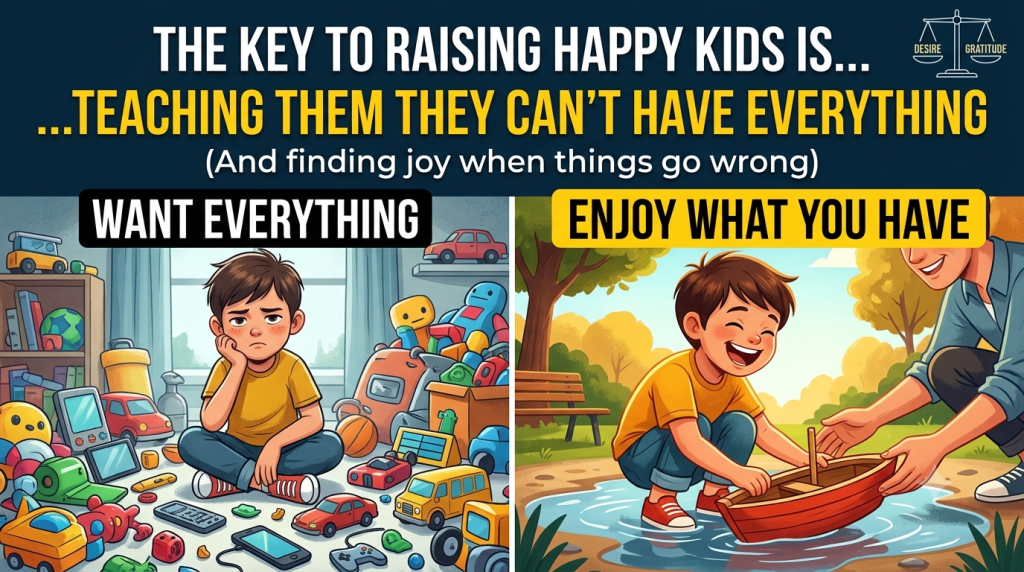
Why the Key to Raising Happy Kids Is Teaching Them They Can’t Have Everything
We live in a world obsessed with giving children the best: the best opportunities, the best toys, the smooth path, the instant yes. We are often told that protecting our children’s joy means keeping their skies sunny and their desires fulfilled.
However, raising happy children requires us to break a fundamental illusion: the idea that life will always give them exactly what they want.
When we teach children to expect perfection, we inadvertently set them up for chronic disappointment. True happiness is not built on getting what we want every time; it comes from learning to appreciate what we have and adapting when life doesn’t go according to plan.
The Illusion of Perfection: Why Getting Everything Creates Entitlement
In your day-to-day life, things rarely go perfectly:
- You look forward to a clear, sunny morning, and it rains.
- You order a pizza, and it arrives with the wrong toppings.
- You buy a second-hand car, and it breaks down two weeks later.
This is the nature of a world shared with billions of other people, each with their own needs and unpredictable circumstances.
When children are raised with the implicit belief that their every wish should be granted, their focus shifts to what disappointed them rather than what is present.
- A slightly cold meal becomes a ruined dinner.
- A minor disagreement with a friend ruins the whole day.
- A delayed TV episode or a missed toy feels like an unfair tragedy.
In psychology, this dynamic is closely tied to the expectation gap. When expectations are artificially inflated, reality consistently fails to measure up. Instead of fostering contentment, giving children everything they ask for trains their attention onto what’s missing.
What Philosophy and Psychology Say About Unmet Expectations
The idea that contentment lies in managing desires rather than indulging them is not new. It spans centuries of philosophical thought and modern developmental science.
1. The Stoic Philosophy: The Dichotomy of Control
Ancient Stoics like Epictetus and Marcus Aurelius argued that human suffering stems not from external events, but from our expectations of those events.
Stoicism teaches the Dichotomy of Control: separating what is up to us (our actions, attitudes, and efforts) from what is not (the weather, other people’s choices, or sudden mechanical breakdowns).
When we raise children to accept that external outcomes won’t always match their desires, we teach them equanimity. When it rains, instead of complaining about the lost sunshine, they learn to appreciate the smell of fresh rain. When a car breaks down, they gain practical experience in problem-solving rather than falling into despair.
2. Developmental Psychology: Building Frustration Tolerance
In modern child psychology, allowing children to experience minor, manageable disappointments is essential for developing frustration tolerance and emotional regulation.
Psychologists emphasise that when children face “violations of expectations” (such as a cancelled plan or a missing toy), their brains practice moving from initial disappointment to emotional baseline.
- Boredom forces them to tap into their own creativity to invent fun.
- Eating what is served expands their palette and builds gratitude.
- Not getting every item on a walk helps them separate a fleeting desire from genuine necessity.
By validating their feelings (“I know you really wanted that toy”) without instantly fixing the problem (“…but we aren’t buying it today”), parents help children realise that disappointment is survival-safe and temporary.
Breaking the Illusion: Practical Ways to Reframe Happiness for Kids
To help children build resilience and genuine contentment, parents can take active steps to break the expectation of constant indulgence:
- Embrace Boredom: Resist the urge to constantly entertain children. Allow empty hours where they must create their own play, which fosters internal motivation and resourcefulness.
- Normalise “No” and Unmet Desires: Practice letting children experience minor disappointments without immediate compensation.
- Model Adaptive Problem-Solving: When life goes off-script—like a wrong food order or a rainy day—demonstrate humour and adaptability rather than frustration.
- Cultivate Active Gratitude: Shift family focus from what we want next to what we have right now.
Final Thoughts
Giving children happiness isn’t about clearing every obstacle or fulfilling every wish. It is about equipping them with the mental flexibility to navigate a world that won’t always cater to them.
When we break the illusion of perfection early on, we aren’t stripping away their joy; we are freeing them to find fulfilment in life as it actually is.
Simone Berliat